


Resale

Circular 01
Abstract Art
Published:
Date
Abstract Art
Colophon
Introduction


The idea behind this Circular is simple. It's much like the brochures that arrive in your letterbox. Rather than advertising school shoes or groceries, it presents a concise, thoughtfully sourced suite of artworks. Each is listed with a price. Once an artwork is sold, it is sold. Sometimes there are second chances in life, but this is rarely true with artworks.
In this inaugural edition, the works are organised around the theme of abstraction. Future Circulars will follow this model, sometimes united by a simple principle and at other times by more complex groupings. On some occasions, the works will be hung for display in the gallery, while other Circulars will exist strictly as documents.
These works are sourced from private collections for resale. The secondary, or resale, market breathes life into artworks. Every time an artwork changes hands, its aura is enriched by thought, discourse and fleeting availability. Each exchange creates new meaning without introducing any new matter into the world. It represents a form of equilibrium and a model for our physical existence.
Abstract painting holds its own sense of circularity. Because it concerns itself with the sum of its parts rather than literal representation, it acts as a mirror to the circumstances of its making, and the world around it. Throughout history, abstract images and their underlying philosophies have been reinvented repeatedly. Viewing a collection of abstract paintings across a broad spectrum of time allows one to observe how certain ideas emerge, vanish and then reappear.
Contents

Agnes Martin is an artist who needs no introduction. She remains a major figure in post-war American art, a period defined by a surge in American cultural production that saw the movement truly come into its own. During the latter half of the 20th century, American art distanced itself from European traditions to embrace scale and vast epic space. The images and the techniques used to create them reflected a deep engagement with the plasticity of the material world and the physical nature of matter itself.
Born in 1912 and passing away in 2004, Martin moved to New York in the 1950s. There, she had regular contact with artists such as Ad Reinhardt and Barnett Newman, becoming a leading proponent of minimalist painting. While her early output includes some figurative works, she is celebrated for her gridded compositions in pale and earthy tones. These are frequently described as serene, meditative or transcendental. Perhaps these terms are attempts to describe the sublime. It is little wonder these descriptors often fall short, as they attempt to articulate that which exists beyond words.
There is no particular symbolism at play in her work. However, squares and rectangles are uniquely human forms that do not occur in nature and always signify human design. In her 1979 essay Grids, art theorist Rosalind Krauss proposed that the grid was originally a hidden tool used for mapping perspective or transferring drawings to canvas. Krauss argued that once the grid became visible, it no longer mapped the natural world but instead mapped the canvas itself. To Krauss, the grid was a way for art to turn its back on nature. This is nowhere more evident than in the work of Martin. Her paintings are the ultimate statement of modernity. They possess no centre, no hierarchy and no climax. They are absolute silent structures insisting that the painting is an object rather than a story.
These two lithographs originate from a portfolio published in 1991 to mark her retrospective exhibition Agnes Martin: Paintings and Drawings 1974 - 1990. This exhibition was a watershed moment in her career. The scale, format and use of vellum represented a constant thread that Martin would return to throughout her practice. Lithography is singular in its ability to capture the thought and execution of an artist, offering a one to one imprint of the original marks that maintains their exact form and tonal qualities. The substrate provides further insight into her thinking. Vellum is a semi translucent paper traditionally used for tracing. For works where the specific quality of the line is so vital, this material choice suggests that these pieces are not merely about the marks themselves but something else entirely.
Published by the Stedelijk Museum, Amsterdam, in partnership with German art publisher and printer Nemela & Lenzen GmbH, Mönchengladbach.
Published on the occasion of the exhibition Agnes Martin: Paintings and Drawings 1974–1990, held at the Stedelijk Museum in 1991.
Private collection, Auckland
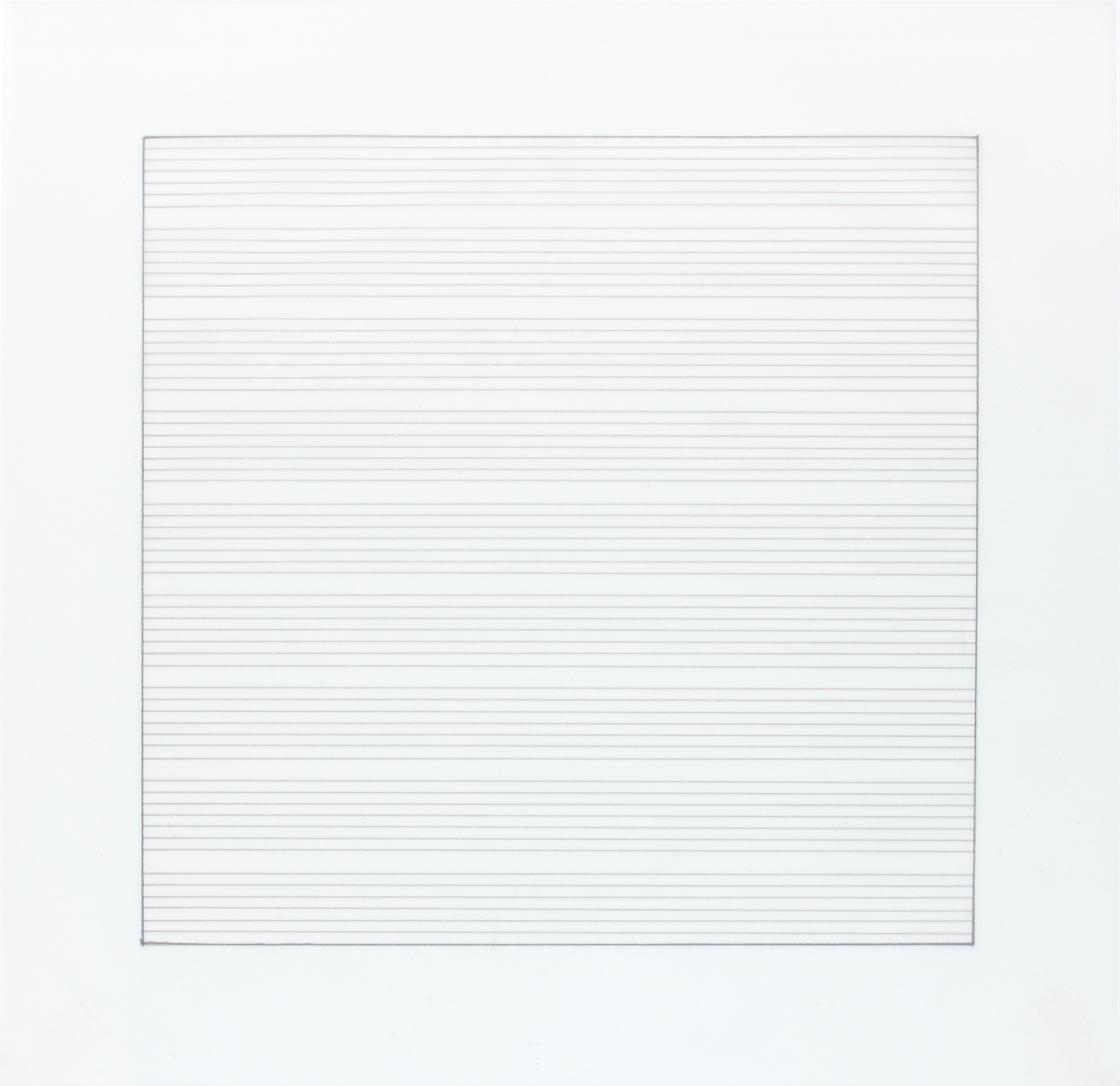
Agnes Martin
untitled
1991
Martin Thompson was an artist who came to prominence under the banner of being an outsider or self-taught artist. He spent the majority of his life living in total obscurity in Wellington and was a familiar fixture for those who lived there during the 1990s and early 2000s. He would wander the city carrying his drawings under his arm. It was not until he was almost 50 years old that his work started to develop an audience, after a tutor at an art studio noticed his talent and began promoting his practice.
Thompson was fixated on mathematics. The forms in his images are based on fractals, which are naturally occurring geometric structures that can be scaled ad infinitum by extrapolating the information within. In the few existing interviews with him, he spoke of how these forms had implications reaching far beyond a two dimensional plane. Fractals and qualitative self symmetry inform all manner of natural and human systems, from the shape of shorelines to the behaviour of financial markets. This symmetry ensures structural patterns or statistical properties remain consistent across different scales of magnification, rather than acting as exact rigid replicas of the whole.
He translated these complex mathematical concepts using simple materials, relying on graph paper and ink pens bought from the stationery store. His artworks were always created in pairs, featuring one light panel and one dark panel designed as exact mirrors of each other. When he made a mistake, he would cut out a small section of the paper. A donor patch would then be used to repair the removed area. By the time they were completed, these works often consisted of many tiny pieces of paper taped together with sellotape on the reverse side. Looking closely at the surface reveals a beautifully gridded pattern signalling where these physical joins were made.
This painstaking physical process and his years working entirely outside the professional gallery sector make pristine examples of his practice extremely rare. In the tradition of cultural heavyweights like Colin McCahon, Thompson made art for decades before being embraced by the art world. Consequently, his works rarely entered the market as carefully preserved objects. Anyone familiar with his practice will immediately see that this specific artwork is a special example. It has been kept in a drawer since it was originally purchased from Anna Bibby Gallery. The colour remains crisp and the only patina it bears are the intentional marks of his own making.
Private collection, Auckland. Acquired from Anna Bibby Gallery, Auckland, c2005.
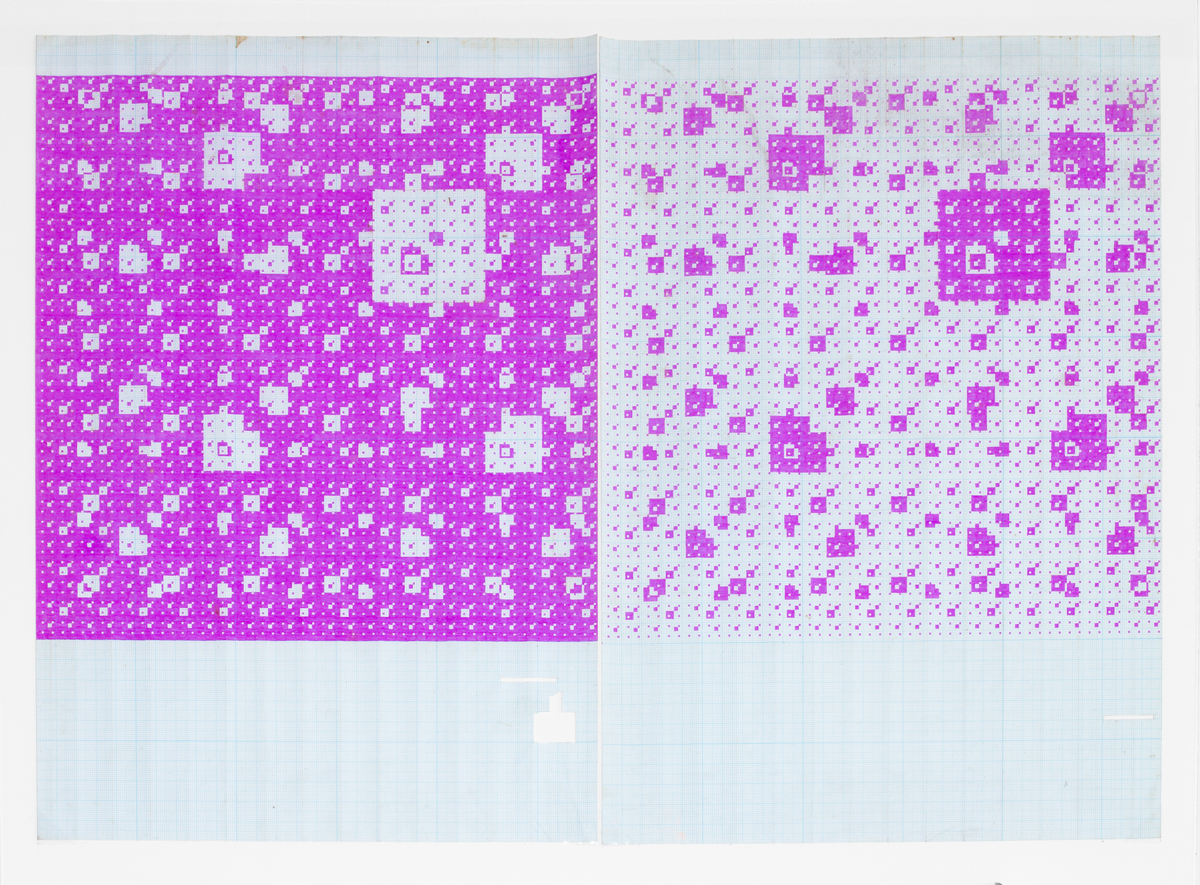
Martin Thompson
untitled
c2005
André Hemer is a New Zealand painter who emerged as an exhibiting artist in the late 2000s. In his early paintings, Hemer used vinyl stencils to apply airbrushing and flat colour to the canvas. The resulting images looked like abstract expressionism made with Adobe Photoshop brushes. They used garish clashing colours and laid the groundwork for what was to come.
Hemer completed a PhD in Fine Art in 2015, prompting a major shift in his practice. His exhibition New Representation at Chalk Horse gallery in Sydney introduced a new approach. He layered his familiar digital strokes with printed inkjet imagery, 3D facsimiles of blobbed paint and hand painted marks. This method merged the real with its depiction. It offered a direct comparison that prompted viewers to meditate on the historical function of painting and its role in modern society. These works gained significant attention. Hemer enjoyed a succession of sellout shows at dealer galleries worldwide, making pieces like this highly sought after. This specific painting was purchased from a Los Angeles gallery.
These paintings share a clear relationship with technology through their use of mechanical reproduction. The works recall the era in the late 2000s when blockchain technology first gained public awareness. As the foundation for cryptocurrency and NFTs, blockchain tracks ownership using a distributed ledger. It relies on numerous digital records spread across different locations that update simultaneously when ownership changes. This system enables decentralised financial instruments free from central control.
Daubs of paint are distributed across the surface of the artwork. Each mark relates to a greater whole, and their glossy finish makes them look almost jewel-like. They act as units of stored potential. The composition reflects the early optimism of a new world order where anarchic rule might offer true democracy and existing systems of control would become relics. Its sentiment feels even more prescient today with the spectre of artificial general intelligence and the fourth industrial revolution on the horizon. Its message is neither pro-technology nor anti-technology but rather the painting of a beautiful moment in an emerging reality.
Blockchain holds a complex cultural legacy, particularly regarding cryptocurrency. On one hand, it is a preferred medium for illicit trade and corruption. On the other, as noted by venture capitalist and Netscape founder Marc Andreessen, it represents the first major technological shift in modern history where retail investors preceded financial institutions. In the exact way these paintings contrast reality with its depiction, they also contrast the idea of an abstract painting with the systems that treat it as an abstract commodity.
Making-Image, Luis De Jesus Los Angeles, 6 January–10 February 2018.
signed AM and André Hemer, dated 2017 and inscribed Deep Surfacing NYC #17 and New York in graphite verso
Private collection, Auckland. Acquired from Luis De Jesus Los Angeles, 2018.

André Hemer
Deep Surfacing NYC #17
2017
Like many of Walters’ prints, Kura was produced in collaboration with Mervyn Williams. Williams was an accomplished abstract painter and a master screen printer. Their professional relationship began with Walters’ contribution to Barry Lett Multiples, a portfolio of prints by leading New Zealand artists which aimed to make artworks available at a democratic price point. The project forged a fruitful partnership that lasted for years. Reflecting on their dynamic, Williams noted: ‘I knew exactly what he wanted and he knew I knew.’
The two men travelled to Sydney together to see a Bridget Riley exhibition in 1975. Riley was a leading proponent of the Op Art (optical art) movement of the 1960s, producing screenprints with geometric shapes and flat colour. In an article marking Williams’ 70th birthday, published in Art New Zealand 136 (Summer 2010–2011), Michael Dunn noted that Williams had encouraged Walters to take his screenprinting beyond editioned works on paper. Dunn quoted Williams as saying the koru form was ‘immensely screen-printable.’ To that end, Williams proposed that Walters make large screen-printed works on aluminium in editions of six. This was a progressive idea; it reads like something a contemporary artist would make today, in 2026. That Williams would present such an idea speaks to the seriousness with which Walters pursued the medium. Considering this ‘what if’ scenario is almost like imagining an alternate history for abstract painting in New Zealand.
Walters was fastidious about the technical aspects of producing screenprints. To create the final screens, he would supply colour samples, a half-size version of the image painted in full colour, and a full-scale version in black ink for the photographic transfer process. The preparatory studies for Kura, held in the collection of Te Papa Tongarewa, provide valuable insight into the work's conception. They show Walters working through various shades of grey before arriving at the final palette. In handwritten notes supplied to Williams, he explained that he greyed the colours of Kura to stop the work ‘jumping around too much’.
signed Gordon Walters, dated 1983 and inscribed "Kura" and 66/150 in graphite lower edge
Private collection, Auckland. Acquired from International Art Centre, Auckland.
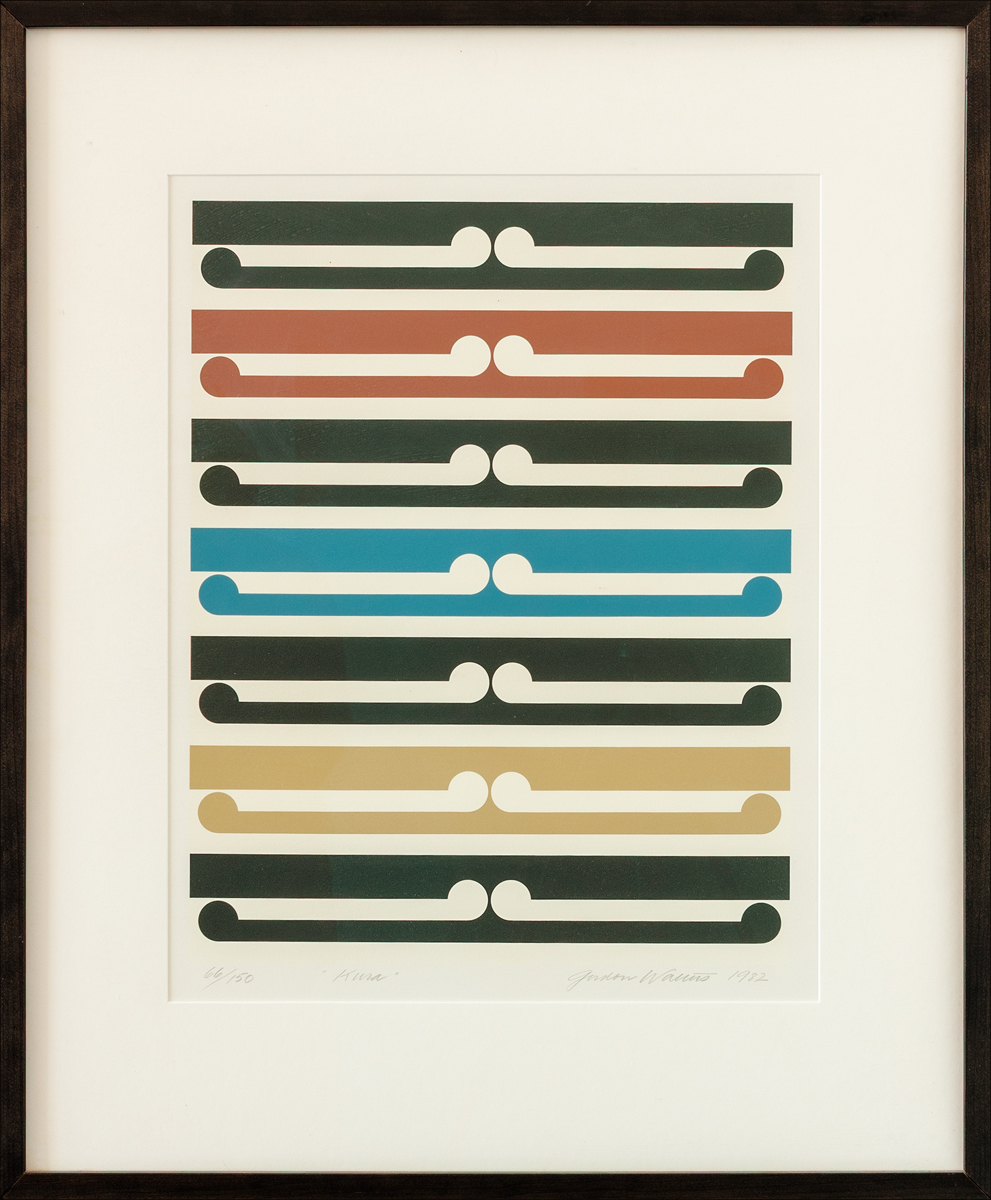
Gordon Walters
Kura
1982
Eddie Clemens is an artist who first came onto the art scene in the mid to late noughties, between 2005 and 2008. A lot of his work is influenced by science fiction. For instance, one of his most well-known works, Delusional Architecture, is based on a scene from Terminator 2 where a character dreams of a nuclear explosion tearing through California. A key shot shows a person clinging to a chain link fence. Clemens used thin electrical wire and PVC tubing to make a life size facsimile of this fence. He then used a knife to cut away sections. Anywhere the cuts exposed the wires inside, he attached a small LED light. When hooked up to electricity, the fence appeared warped and melted, with hot glowing embers surrounding the areas where it had totally broken down. Just as the filmed miniatures created a nuclear meltdown in one's mind, Clemens's Delusional Architecture brought a fictionalised version of an advanced society to the here and now.
Other works by Clemens look at similarly mundane objects from our day-to-day lives. They are often things that speak to larger structures of organisation and control. For instance, he has made works from the ball chain used to tie down pens at a bank or customs desk. He has also made works, like this one here, with receipt paper. Anyone who has spent time working in retail or hospitality knows that red lines appear when you reach the end of a receipt roll. These lines signal it is time to change the roll. Clemens has taken a number of these roll ends and arranged them in a row, using the red lines to create an abstract composition.
The work is titled End of the Waterfall. At the bottom of a waterfall is a crash, where bodies of water collide. It is no coincidence that this work was made in 2008 against the backdrop of the Global Financial Crisis. It responds to the place and cultural history of its creation. One cannot use the word waterfall in New Zealand art without calling on the legacy of Colin McCahon. In the mid 1960s, McCahon made a beloved series of paintings based on the simple visual device of a white line set against a black background, known as the Waterfall series. This raises the question of whether Clemens is making a punk statement early in his exhibiting career. He might be telling the old guard to move over because the future has arrived.
Private collection, Auckland. Acquired from Bowerbank Ninow, Auckland, 2015.
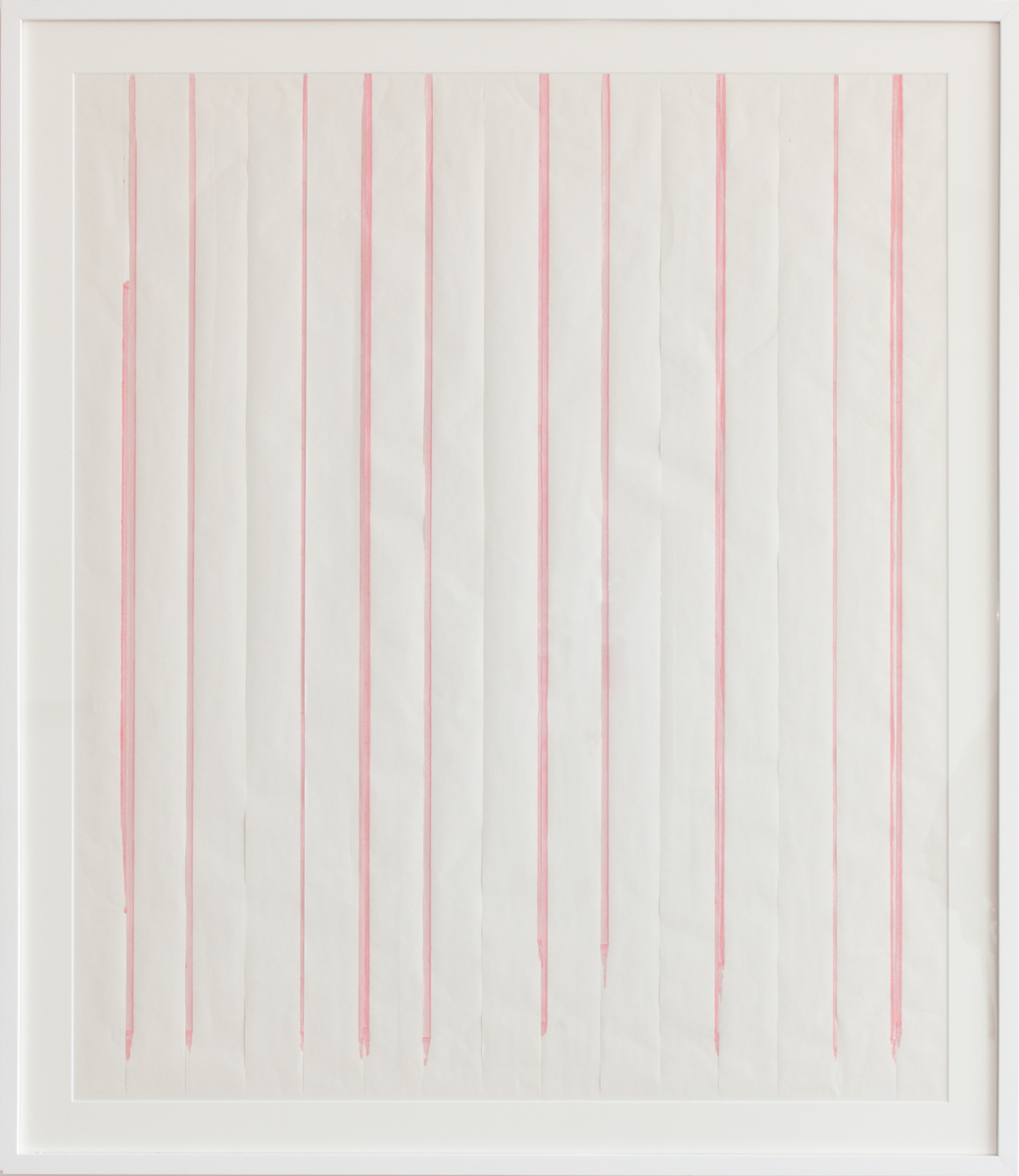
Eddie Clemens
The End of the Waterfall
2008
Published by the Stedelijk Museum, Amsterdam, in partnership with German art publisher and printer Nemela & Lenzen GmbH, Mönchengladbach.
Published on the occasion of the exhibition Agnes Martin: Paintings and Drawings 1974–1990, held at the Stedelijk Museum in 1991.
Private collection, Auckland
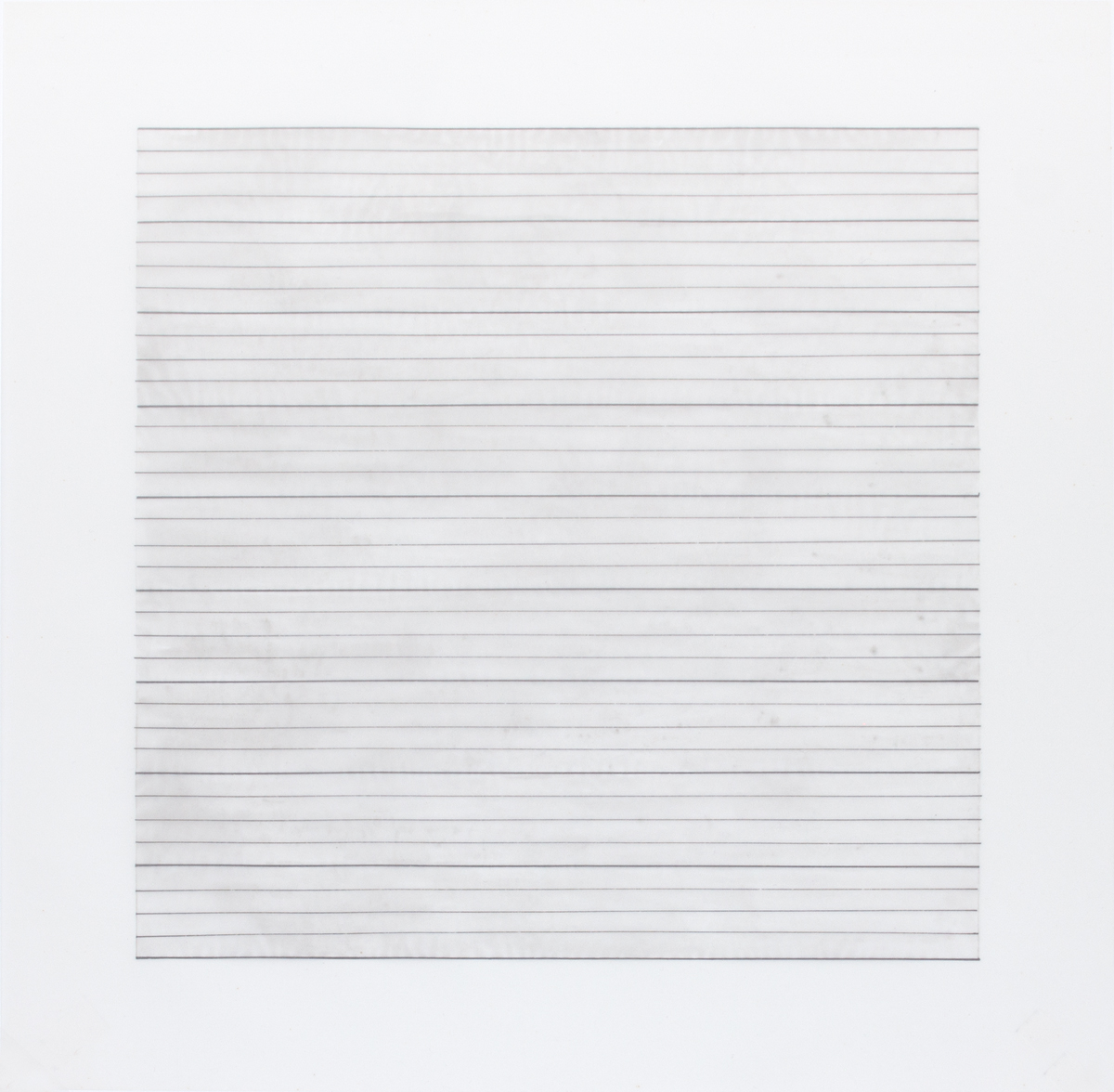
Agnes Martin
untitled
1991
inscriptions
all fees and GST.
Provenance
Exhibition history
Publisher
Notes
Lorem ipsum dolor sit amet, consectetur adipiscing elit. Mauris congue justo sed neque ultrices congue. Etiam efficitur lorem massa, a viverra ex malesuada at. Sed eget sem turpis. Ut semper lobortis justo. Nam congue nisl eget leo vehicula, vitae imperdiet ligula finibus. Etiam egestas pellentesque ante, ut placerat magna facilisis luctus. Nullam neque augue, consequat quis volutpat vitae, gravida consectetur quam. Cras commodo vitae felis ornare feugiat. Donec nec sapien sem. Ut quis accumsan arcu. Sed venenatis vestibulum erat, id finibus erat interdum commodo. Vivamus at orci risus. Sed id justo nulla. Duis sed finibus ante, at gravida velit. Suspendisse faucibus neque elit, eu fringilla augue pretium vitae. Ut non ligula eu magna pulvinar condimentum id in nisl.
Nam lobortis, tortor ut varius sagittis, odio diam tempor purus, vel viverra urna est id diam. Morbi sit amet ligula eu augue porttitor laoreet. Maecenas porta velit sed tempor fringilla. Mauris at turpis semper dui ultrices pulvinar eu ut odio. Aliquam iaculis dui at tellus elementum, in faucibus velit condimentum. Nam non dapibus nisl. Vestibulum sodales tincidunt arcu, in luctus neque auctor nec. Etiam magna libero, elementum eu ligula a, auctor consequat enim. Curabitur vitae feugiat ante. Sed non dignissim turpis. Maecenas lobortis quis purus a venenatis. Lorem ipsum dolor sit amet, consectetur adipiscing elit.
Suspendisse dignissim leo quis ipsum sagittis auctor. Maecenas nunc metus, hendrerit eget enim sit amet, viverra dapibus velit. Class aptent taciti sociosqu ad litora torquent per conubia nostra, per inceptos himenaeos. Etiam mattis libero eu est lacinia, sed cursus purus venenatis. Nam dictum imperdiet dignissim. Nullam purus est, congue egestas laoreet consequat, luctus vitae velit. Duis vitae eros convallis, ultricies neque eget, ullamcorper dolor.
Cras nec nisl eget purus ultrices egestas. Donec varius nisi ligula, vitae imperdiet augue varius nec. Cras ut metus maximus, ullamcorper ante vel, facilisis purus. Quisque viverra sed dui sed sodales. Phasellus ultrices hendrerit eros, sit amet ornare arcu interdum vel. Etiam condimentum lacus sapien, eget pharetra dolor rutrum in. Etiam maximus erat quis pulvinar ornare. Donec id tortor non urna tristique suscipit eget vel massa. Fusce nec eros nisl. Donec sollicitudin elementum.